Tag: experimental television center

  • The Wobbulator

    I was finally able to cobble together a video for Nam June Paik’s Wobbulator. It was one of my favorite pieces of equipment during my residency at the Experimental Television Center, and I was confused about why there wasn’t a lot of information out there about it on the web. There are a few grainy youtube videos but they don’t show a lot of the exterior of the device or any of the real time manipulations, so I wanted to make a little educational video. Most of the Wobbulator’s source images in this video were either from a camera pointed out a window, or just from straight video feedback.

    For a lot more information, check out the Experimental Television Center’s website in their Video History Project area. There are tons of great articles on early analog video tools and techniques, but in particular there is a very detailed article on the wobbulator. Just to give you some more info, here is the first paragraph of the article on the device:

    A raster manipulation unit or ‘wobbulator’ is a prepared television which permits a wide variety of treatments to be performed on video images; this is accomplished by the addition of extra yokes to a conventional black and white receiver and by the application of signals derived from audio or function generators on the yokes. The unit is a receiver modified for monitor capability; all of the distortions can thus be performed either on broadcast signals or, when the unit is used as a monitor, on images from a live or prerecorded source. Although the image manipulations cannot be recorded directly, they can be recorded by using an optical interface. The patterns displayed on the unit are rescanned; a camera is pointed directly at the picture tube surface and scans the display. The video signal from this rescan camera is then input to a videotape recorder for immediate recording or to a processing system for further image treatment. The notion of prepared television has been investigated by a number of video artists and engineers; this particular set of modifications was popularized by Nam June Paik.

    I also made a quick music video with the wobbulator as a key component…check it out here

    For more on my experience at the experimental television center check out a few of these links
    [1] [2] [3] [4]

    This video is now featured on Rhizome, Create Digital Motion, Hack a day, Makezine, Wired and Notcot among others
  • The first of videos from the ETC

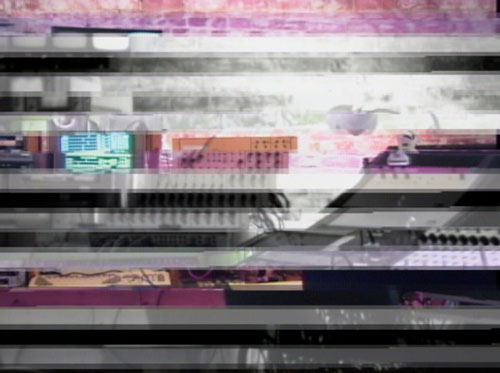
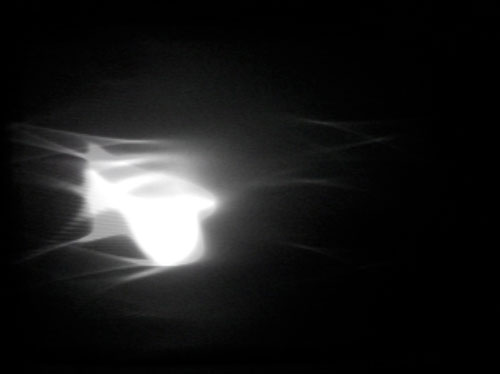
    The first of 4 or 5 videos that I churned out at my residency at the experimental television center. Both of these were made on my last day there…they mostly came about because the song would randomly come on while i was working and it just happened to click with what I was doing at the moment. Both are kind of slow burn and minimalist. Enjoy!

    I’ll just copy and paste from my vimeo:

    An experimental video made while in residency at the Experimental Television Center in Owego, NY. This song happened to come on randomly as I was working with a set of cameras, and this is what I ended up with.

    The entire video was (sort of) made in one shot. I set up 4 cameras pointed at different parts of the scene, and used audio triggers from the song to automatically switch between the cameras. All camera switches were unique to the time I played the song back, so I couldn’t really plan for a progression.

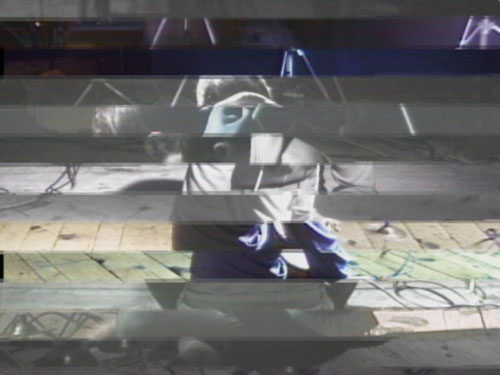
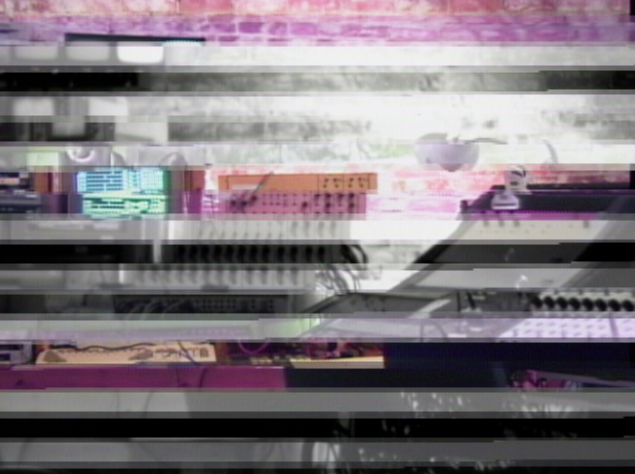
    The first pass was recorded off of the screen of the wobbulator to give it a security camera feel. i then played back that first pass back through the wobbulator again and had the audio drive the drawing of the scanlines, resulting in the jiggling lines of the video. You’ll notice that bass sounds result in an all over image wobble, while high notes are more visual as you can see their frequency in the lines.

    And another:

    Part of an experiment with multiple cameras and rapid switching at the Experimental Television center. Attempt at making a live lo-fi bullet time/stop motion look.

    This video was all done live and in one take using 8 different cameras and an automated switcher. Some layering and color correction was done in Final Cut Pro afterwards. I mostly left it in gritty SD because it was already the product of 8 cameras, 4 of which were late 70’s/early 80’s black and white cameras. Everything was then run through the Jones sequencer which was controlled by an oscillator running at a variable speed.

    The colors are off because when something is run through the ETC system, it’s chroma phase gets thrown off by each new device it goes through. I tried to do as much manual correction of the hue as I could, but I ended up leaving it in all different colors to differentiate the cameras a little bit.

  • ETC: Day 5 and 6

    Saturday was mostly a blur of activity. I hit a kind of lull at the end of friday in terms of thinking of ideas, but I got several things done yesterday. I made a couple drafts for simple music videos for random songs that came on shuffle. Everything was very tied into using the Jones Sequencer and having it switch based on audio cues. I tried another lo-fi bullet time experiment as well with more cameras and a more exact setup. I tried to focus on the idea of making a video in a single shot…whatever actions I could fit into the space of a song, that would be the entire completed video.

    All in all I have maybe 5 or 6 pieces that will be edited down into final projects over the next few weeks which is exciting…some of them I’m more interested in than others, but here is a list of what I came up with:

    1. Short documentation video on the Wobbulator
    2. Video for Gayngs – Walker
    3. Video elements/ideas for The Velvet Teen – No Star
    4. Video for Metric – He lied about death (cover of a Stars song)
    5. Drum circle performance piece

    There are a few other random source pieces that I gathered and in total I have about 40 to 50gb of stuff I’ve gathered this week..not bad for being all on my own.

    I’ve learned a lot of interesting things this week…despite being turned off by some of the look of analog video effects and things of that nature, digital video still has a lot of different things to catch up to in many other areas. After spending years with my jitter performance patch, I am very used to the responsiveness of digital interfaces for video effects, but with analog everything was just that much faster for my brain to feel way more connected to my actions…the difference of a few milliseconds was all it took. Turning knobs on oscillators, while faster, also felt very unpredictable but it was a welcome unpredictability..something to be mastered. Also, having a constant framerate despite pumping tons of things into the system was something that I had to get used to.

    I was also struck by the ability to use multiple sources with analog equipment. I’m no stranger to TV switchers and things like that, but the Jones sequencer seemed like something that would be completely impossible for digital visualists. The fact that I could live switch between 8 sources from between ~1 and ~20000hz was really amazing, and it was part of the reason why I used the sequencer so much. I’m so used to being able to plug in one firewire camera and maybe mixing in some source video from my harddrive, but not much more than that…the ability to work with multiple sources at such a rapid rate was really great.

    It was also interesting to come here with my two HD cameras and realize a place like this is in a sort of arrested development. None of the equipment here will ever work with resolutions greater than standard definition and it’s confusing to think about that. Now we can do many of the same things in software at whatever resolution we want, but it’s definitely missing this physical element of plugging crazy boxes together and crossing your fingers. When talking with Hank Rudolph he said one of the points of the center is about real-time interaction and real-time experimentation, and that’s really what it communicated to me. He seemed skeptical of HD because people ended up trading some of the interesting things that were happening with video for greater resolution instead of greater speed…and so rendering times end up falling behind real-time. I’m sure we’ll get there eventually, but for now this place is still an incredibly important resource.

    Many thanks to Sherry Hocking and Hank Rudolph for allowing me time here, it was really an eye opener and I hope to return again soon.

  • ETC: Day 4

    I feel like I’m starting to run out of steam today. Yesterday felt comparatively productive, but I’m not too upset since I’ve been getting a lot done these past few days. Today I learned one of the last pieces of equipment, a framebuffer that runs off of an old Amiga computer (loaded off two floppy disks). It allows you to store 32 frames in a circular buffer, and you can play the buffer back as a loop and replace certain frames as you go around to make animations. The catch is that it only operates with 16 gray levels and 256 lines of resolution. You can however replace each gray level with a different color if you wish for simple color mapping.

    After that, I wandered around town, hit the local candyshop, and tried to clear my head for a little while. There is an amazing, huge bookstore right across the street that primarily sells antique books. I looked through several arithmetic textbooks from the 1800s, one of which had an addition table and a subtraction table (in addition to a multiplication table).

    When I came back, I tried another lo-fi bullettime experiment using audio triggers. I spent the rest of the afternoon running my jitter patch in and looping it back around as a source and manipulating the feedback overtop of the source video…but that proved to be a difficult beast to tame. I then turned to reddit to find out if any of my fellow nerds had any interesting ideas for the equipment I hadn’t thought of yet, but I haven’t hit a goldmine yet.

    The rest of the night has been trying to get a handle on using the +/- 5V oscillator bank to generate video signals, and then playing more with simple feedback and audio triggers on the wobbulator. No big plans for the last full day tomorrow except to gather some more random source footage and begin to pack up.

  • ETC: Day 3

    Whew..long day..hence making this post after midnight. After another lesson on the Sandin video manipulator and the Jones sequencer, I had a full day ahead of me. After writing last night I made a gigantic feedback loop using 3 monitors, 3 cameras and two computers running skype. The results weren’t that interesting but I achieved about a .5 second delay through the whole system…it was fun to set up at least.

    After learning the Jones sequencer, a device which uses an oscillator to switch between 8 different sources, I set to work with a couple projects. The first thing that came to me was to make a sort of lo-fi ‘bullet time’ effect with the 7 cameras available here. At first i set them all up in a semicircle pointing at a central point, and it worked to a point, but the inaccuracies in my pointing ended up throwing it off..but the result looked like a weird kind of slit scan hybrid. Still working on the sync for this one…

    Then I spent some time getting more documentation of the Wobbulator. There doesnt seem to be any quality videos of it around the internets, so I’m going to try and cut together a good sample of footage. Got some really nice patterns going today.


    I returned to the bullet time concept after trying a few other random experiments. This time I arranged the cameras in a circle around a central point, and this was a little more interesting looking. I got footage of myself walking around and other confusing looking 7-viewpoint images. Then I had an idea for a goofy piece I’ll be calling ‘Drumcircle’

    By using a mic as a trigger, I used different drum pieces around the studio to change the viewpoint of the camera as I hit the drums. I did a couple iterations of this piece, with a simple slow, self triggered switch, and a few with automated, oscillator driven camera switches. Hopefully it all works out..I may have to try again tomorrow if I can figure out how to get my audio trigger to be a little more responsive.

  • ETC: Day 2

    Another day in fabulous Owego at the Experimental Television Center (need I remind you it was voted the coolest small town in America by the readers of Budget Travel Magazine!). Last night I took a long timelapse out my window and let it run until this morning. Came out ok, but was about as exciting as most timelapses are…I have a better idea for tonight, but I’ll have to see how it plays out.

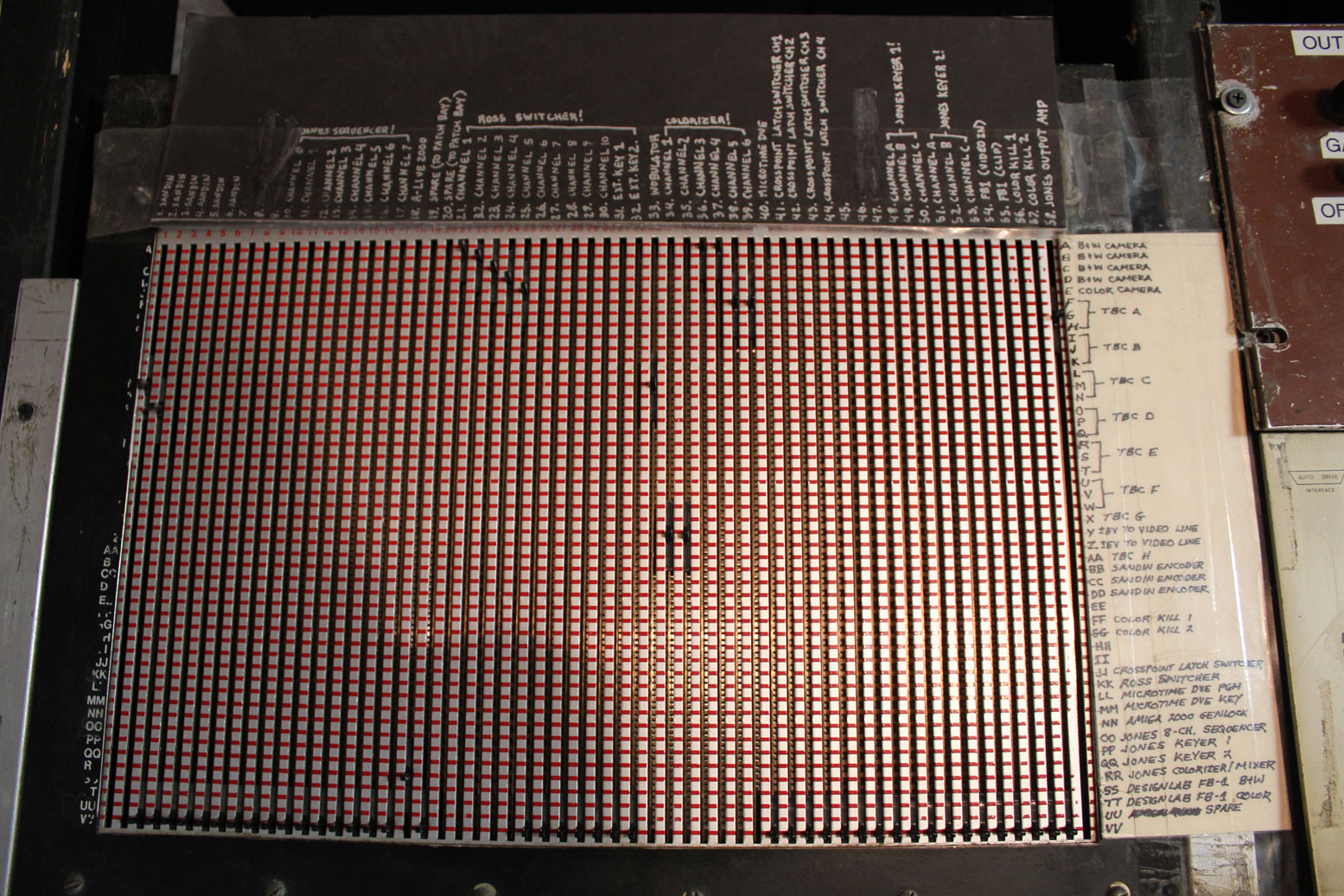
    After breakfast, my first lessons on the ETC system began led by the incredibly patient and knowledgeable Hank Rudolph. After flipping on three power strips, the entire beast sprang to life. I was run through the relatively simple router for getting my inputs and outputs to their final destinations. The really impressive piece for me is a 64 x 64 switching matrix where absolutely everything is labeled and used.

    (Click all images in this post for a larger size..way more pictures in a picasa link at the bottom!)

    That’s 64 separate sliders with 64 positions each. Essentially everything in the system can be run into everything else with a few relatively mild exceptions….it’s a really impressive piece of technology. We then moved onto the Jones keyer, a custom luminance keyer that is controllable by control voltages (CV) provided by an external oscillator or MIDI. Next was the Jones Colorizer, a 4 channel color mixer that is also controllable by CV, and the Ross Switcher, a pretty straightforward video switcher. Pictures and other fun stuff after the jump!

    (more…)

  • ETC: Day 1

    I arrived in Owego, NY (no not Oswego…) in the mid afternoon and wandered down the tree lined streets to the ETC. Owego, apparently one of the “coolest small towns in america” is really nice. It’s a very interesting mix of downtown and residential. Coming in the fall is really great because everything has that sort of overcast look to it, while the trees are exploding with color. I sort of expect small towns to eternally look like they do in the fall. I would like to see this place under a blanket of snow though. Also, this is the kind of place where people will ask you why you’re taking pictures of the surroundings…

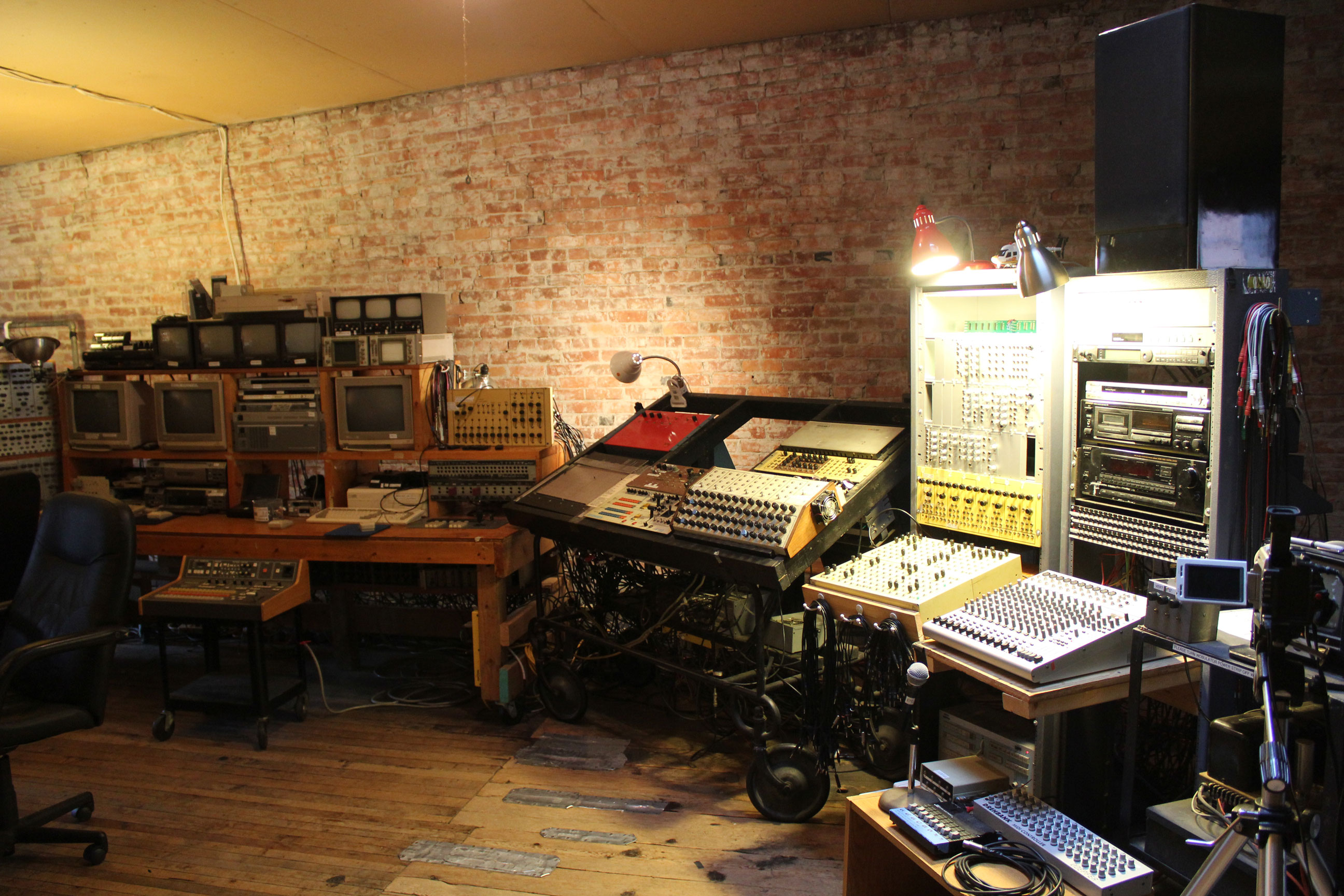
    Arriving at the Experimental TV Center, up the stairs past the storage area of a gift shop, I actually went into the office at first. I was saying to myself “Oh…is this all?” There was a desk, futon for sleeping, wall of tapes and a toilet facing the Susquehanna river with no curtain to hide yourself. After relaxing in there for a while, I decided to poke around to see if I had missed something. Opening the adjacent door, it was like that scene in the Goonies where they find the secret ship room full of One Eyed Willy’s treasure. Words of course, don’t do it justice:

    (Click images for the larger version)

    There will be more detailed pictures and descriptions after the jump. Tomorrow I learn how to actually turn the equipment on and how to patch my computer into it and stuff like that.

    Lots more pictures after the jump!

    (more…)